Eloping used to mean one thing. Two people, a courthouse, a secret. The kind of thing you told your parents about after the fact and spent the next decade explaining at family dinners.
That’s not what eloping in Ohio looks like in 2026.
Today, couples who choose to elope are not cutting corners. They are making a deliberate decision — to spend their wedding day in a setting that actually means something, surrounded by the people who actually matter, without managing a guest list of 150 people who mostly matter out of obligation. The average Ohio wedding now costs between $33,000 and $40,000. A meaningful fraction of couples are looking at that number, looking at each other, and asking a different question: what if we spent that money on an experience instead of a headcount?
This guide answers the practical questions that follow. How to get a marriage license in Ohio. What it actually costs to elope here. Where to do it — and why the working farms of Northeast Ohio’s Grand River Valley wine region offer something that state parks and courthouse steps simply cannot.
What Eloping in Ohio Actually Means in 2026
The word ‘elopement’ has shifted enough in recent years that it’s worth defining before you start venue shopping. There are three formats couples are choosing from, and they describe genuinely different experiences.
A true elopement is just the two of you — plus an officiant, usually a photographer, and sometimes one or two witnesses. The ceremony is the focus. No reception required. The day belongs entirely to the couple.
A micro-ceremony expands that to somewhere between 5 and 30 guests — immediate family, closest friends, the people who would drop everything if you called. It includes a ceremony and usually an intimate dinner, but none of the production of a traditional wedding. No obligation invites. No seating chart headaches.
Nationally, elopements and micro-ceremonies have grown by roughly 74 percent over the past decade. In Ohio, the trend mirrors the national picture but with a regional edge: couples from Cleveland, Columbus, Pittsburgh, and beyond are discovering that they can drive two hours and land somewhere that feels like a genuine destination — wine country, working farmland, private acreage — without a passport or a long-haul flight. Ohio is closer to remarkable than most people realize.
Ohio Marriage License: What You Need to Know Before You Elope
Ohio’s marriage license process is straightforward, and it moves faster than most couples expect. Here is what you need to know before you book anything.
Applications are handled by the county probate court. If at least one of you is an Ohio resident, you apply in the county where that person lives. If neither of you lives in Ohio, you apply in the county where the ceremony will take place. For couples eloping at Standing Rock Farms in Madison, that means Lake County Probate Court in Painesville.
Lake County now requires couples to start the process online through the Lake County eMarriage portal — both of you submit your information, pay the $70 fee by credit card, and then schedule an in-person appointment together to finalize the license. Walk-ins are not accepted. Plan to schedule your appointment at least two to three weeks before your ceremony date.
The license is valid for 60 days from the date it is issued. There is no waiting period in Ohio — if your appointment is the morning of your ceremony, you are legally permitted to marry that afternoon. Bring valid photo ID for both parties. If either of you has been previously married, bring a certified copy of your divorce decree, dissolution, or death certificate.
Do You Need a Witness to Get Married in Ohio?
No. Ohio law does not require witnesses to be present at a marriage ceremony. It is just the two of you and an authorized officiant.
Do You Need an Officiant to Elope in Ohio?
Yes. Ohio does not permit self-solemnization — you cannot legally marry without an authorized officiant present. That person must be an ordained or licensed minister registered with the Ohio Secretary of State, a judge, a mayor, or another individual authorized under Ohio Revised Code Section 3101.08. After the ceremony, your officiant has 30 days to return the signed license to the probate court.
Places to Elope in Ohio: Matching the Setting to Your Vision
Where you elope in Ohio matters more than most planning guides admit. The setting is not a backdrop — it is the experience. Two people exchanging vows in front of a waterfall in a busy state park is a completely different day than two people exchanging vows on 450 private acres with no strangers in sight. Both are valid. They are not the same thing.
State Parks and Public Land
Hocking Hills State Park and Cuyahoga Valley National Park are Ohio’s most searched elopement locations for good reason. The landscapes are genuinely dramatic — waterfalls, sandstone gorges, old-growth forest. If your vision is wild and off-grid, these are legitimate settings.
The practical realities are worth knowing before you commit. Ceremonies on public land generally require a special use permit, which involves a separate application process and approval timeline. The setting is shared — other visitors will be present, and your ceremony will happen in a public space. There are no on-site lodging options, no vendor kitchens, and no getting-ready facilities on the property. You handle all of that off-site.
Best for couples who want a purely natural, rugged setting and do not need lodging or catering as part of the experience.

Private Farm Venues in Northeast Ohio
The Northeast Ohio wine country corridor — Lake and Ashtabula counties, Grand River Valley American Viticultural Area — offers a third option that most Ohio elopement guides miss entirely. Private working farms with dedicated ceremony spaces, on-site lodging, and more than 30 wineries within a 15-minute drive.
No permit required on private property. No strangers moving through your ceremony. The couple, their guests, and 450 acres of rolling fields, forests, and lakes that feel entirely like theirs for the day. The ceremony, portraits across the property, the wedding night in a private cabin with a hot tub, and a winery toast the following morning — all of it within a few square miles of each other.
This is the part of the Ohio elopement picture that is genuinely undercovered. And it is where couples who have done their research consistently end up.
How to Elope at Standing Rock Farms in Madison, Ohio
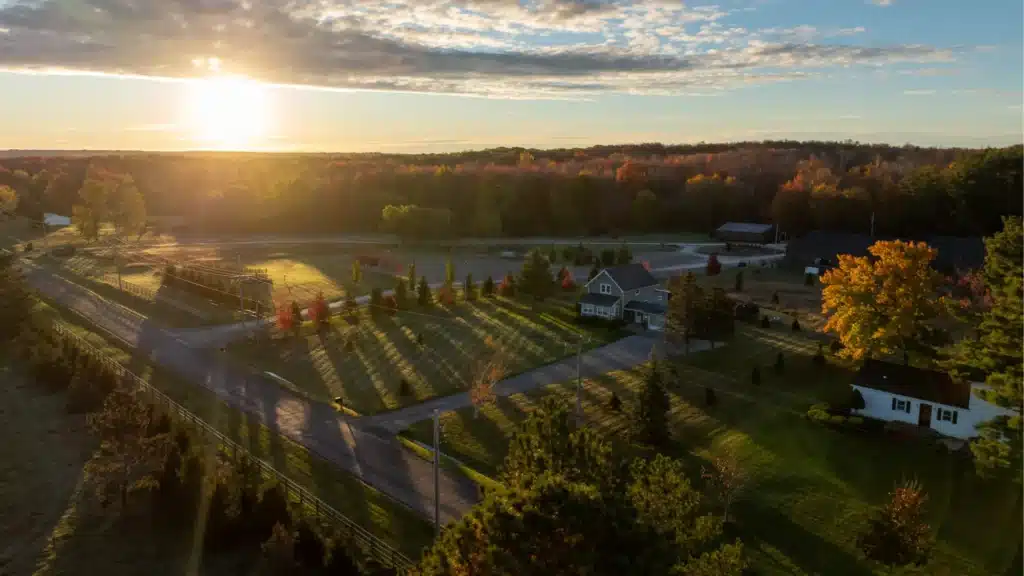
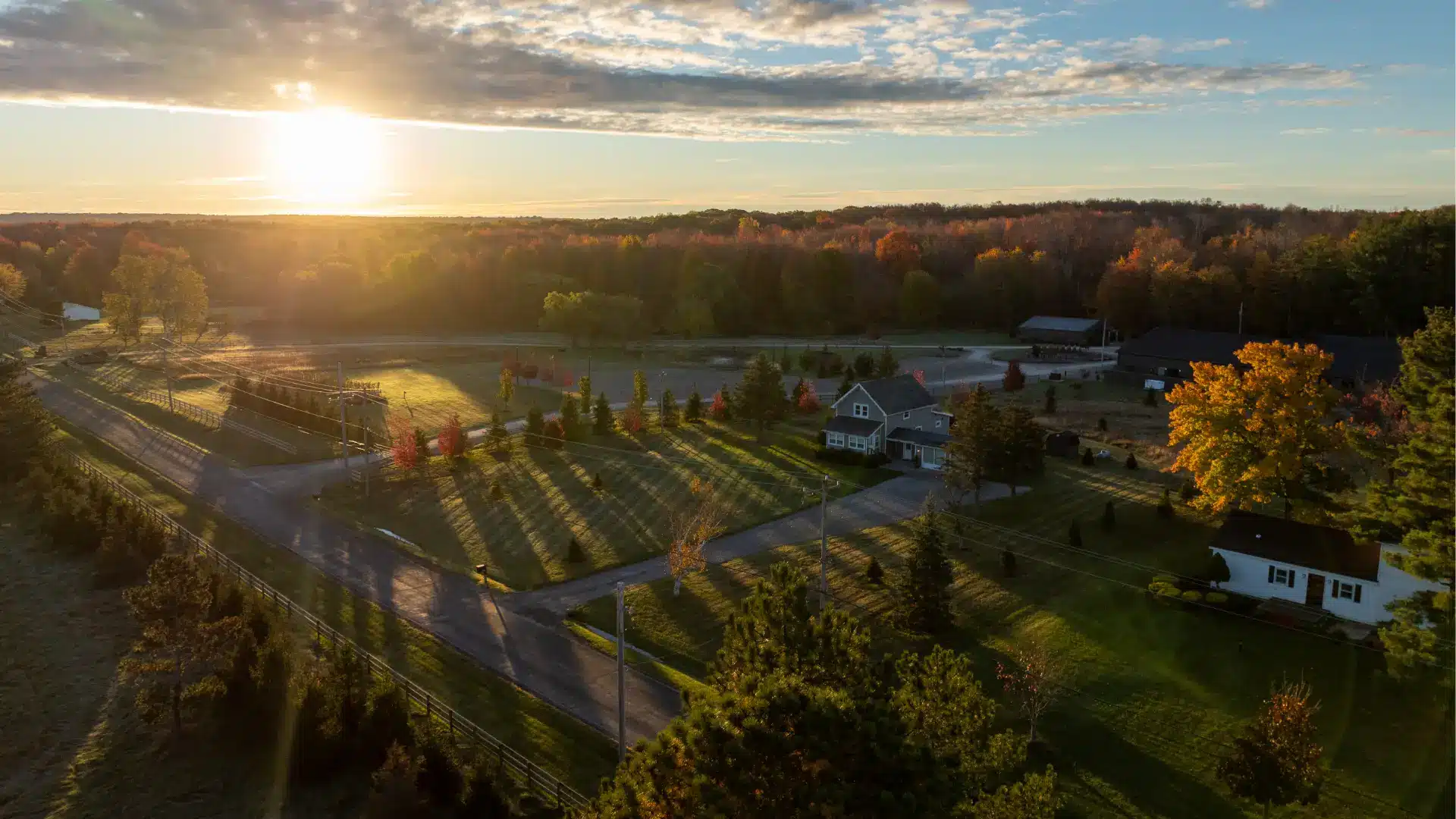
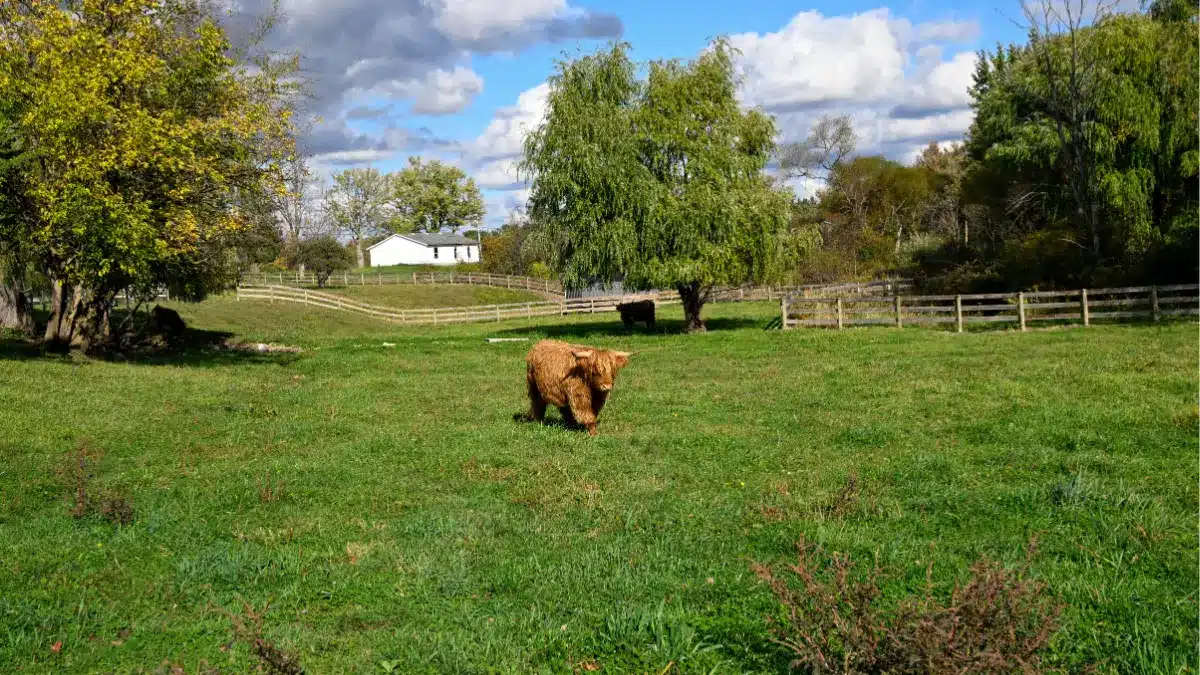
Standing Rock Farms sits on 450 acres in Madison, Ohio — Lake County, Grand River Valley wine region, 45 minutes east of Cleveland. It is a working farm in the most literal sense: registered Scottish Highland cattle graze the open hillsides, 25 acres of commercial flower fields run through the property, an apiary produces honey on-site, and an organic garden and orchard complete a farm that was growing long before it was ever a wedding destination.
Mike and Chelsea Palubiak acquired the land in 2020 — a former Boy Scout camp called Stigwandish, named after a Seneca chief whose name means ‘standing rock,’ which had sat quietly on 352 acres since 1930. What they built over the following years is not a venue that borrowed a farm aesthetic. It is a farm that also happens to be one of the most complete elopement settings in Ohio.
For couples planning an elopement or intimate micro-ceremony, SRF has three dedicated spaces — each designed for a different guest count and atmosphere.
The Ceremony Barn — 5 to 50 Guests
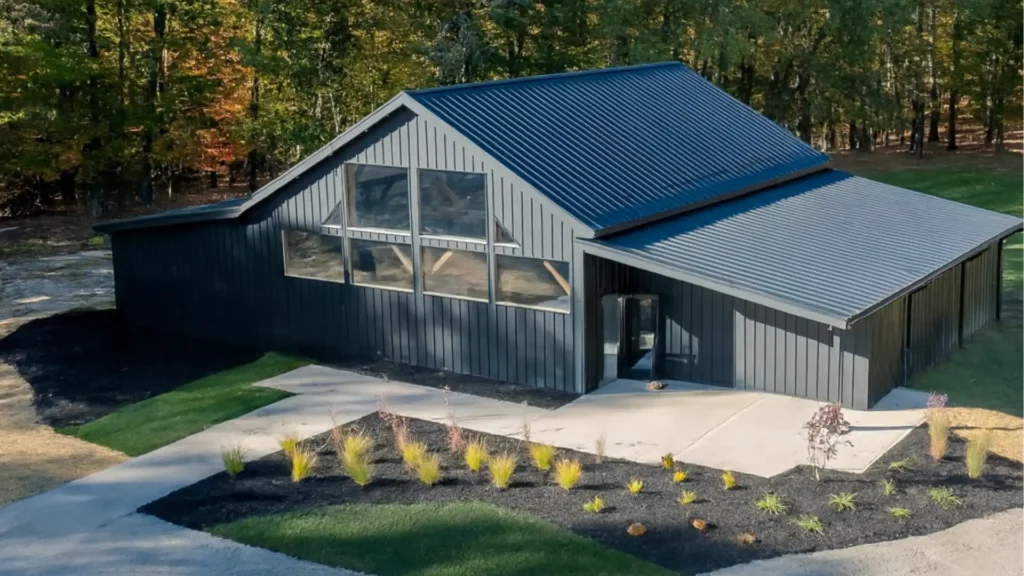
The Ceremony Barn is a dedicated indoor ceremony space within the Flower Farm complex on the south side of the property. Twenty-five handcrafted live-edge benches — each made from timber harvested on the farm — face floor-to-ceiling windows that open to the surrounding woodland and seasonal flower fields. Exposed timber-frame trusses. Polished concrete floors. Climate-controlled year-round.
In summer, the flower fields beyond the windows are in full bloom. In winter, snow-covered hillsides frame the vows through the same glass. The Ceremony Barn is designed around subtraction — the natural setting does the work, and the architecture stays out of its way.
The Carriage House, a three-story getting-ready facility with a private bridal suite, full kitchen, and groom’s quarters, is steps away from the Ceremony Barn.
The 1837 Barn — 5 to 30 Guests
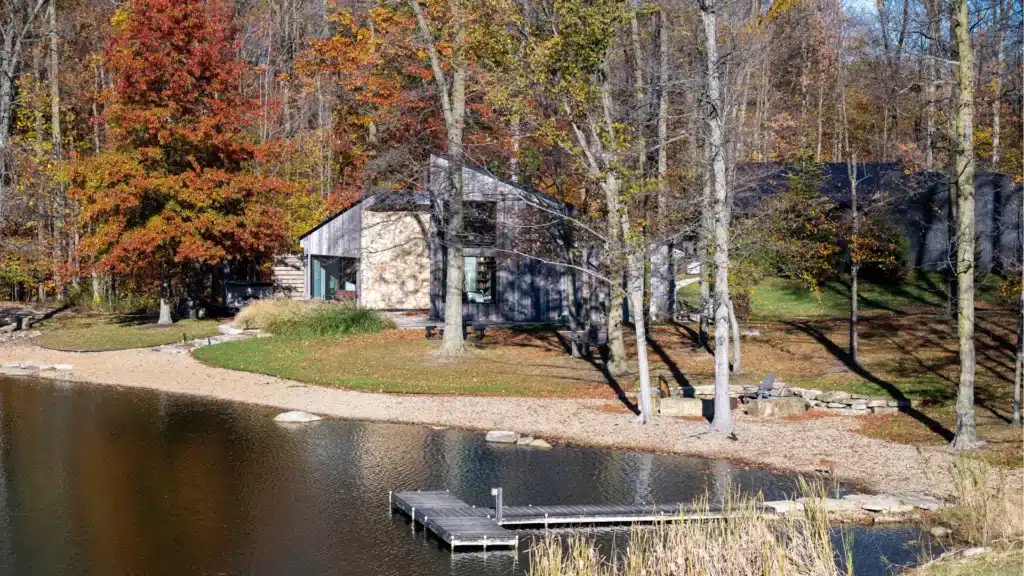
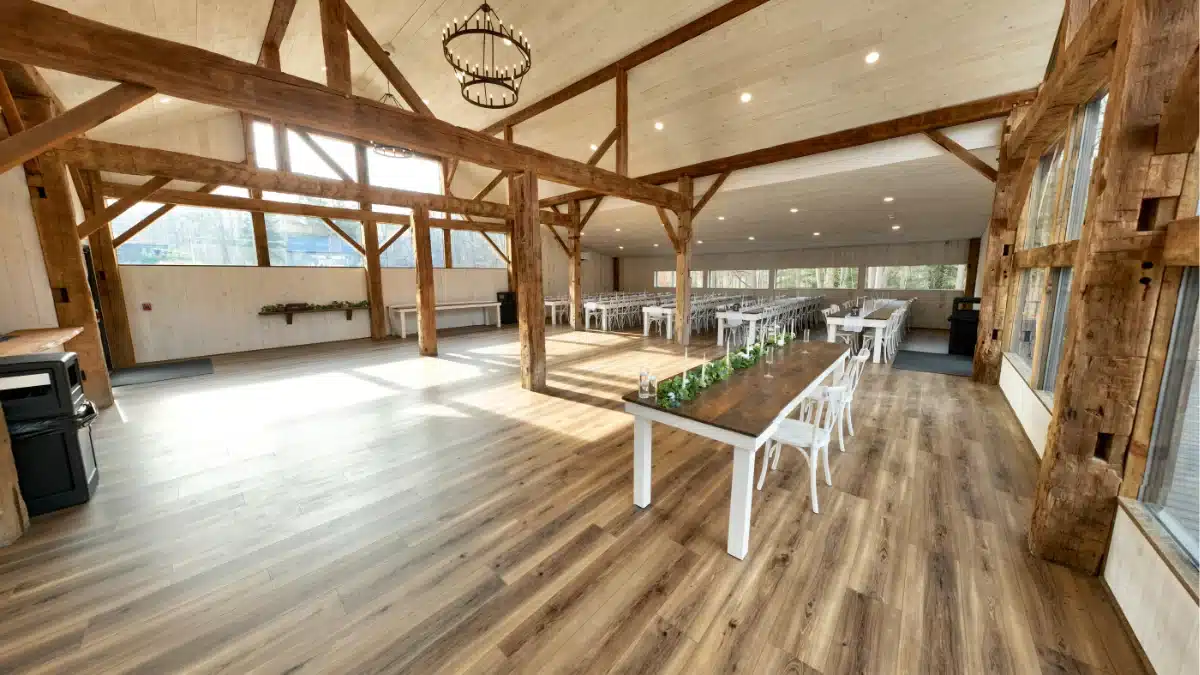
Originally constructed in 1837, the 1837 Barn was carefully dismantled and rebuilt beam by beam on the Standing Rock property — every hand-hewn timber and original carving preserved. The result is a 2,600-square-foot venue with soaring ceilings, exposed historic beams, oversized windows with wooded views, and a 1,200-square-foot outdoor patio. A 4-acre private lake borders the property.
At 20 to 25 guests the space feels generous and unhurried rather than echoing. A caterer’s kitchen, full-service bar, and handcrafted tables are included with the rental. For elopements, the 1837 Barn’s scale is the point — a room that was made for intimacy, not one that tolerates it.
The Barrel Room — Intimate Groups Up to 150
The Barrel Room offers 4,000 square feet of event space with a dramatic open bowstring truss ceiling, a full-service bar, a private catering kitchen, and a 1,600-square-foot enclosed patio overlooking a wooded creek. For micro-ceremonies on the larger end — 20 to 30 guests who want indoor-outdoor flow and a candlelit dinner atmosphere — the Barrel Room delivers without feeling oversized. Separate Bride’s Quarters and Groom’s Quarters, each 500 square feet with private decks, are available for the getting-ready portion of the day.
The Elopement Night: On-Site Lodging
Twelve on-site lodging units mean the couple and their guests stay on the property. The Carriage House serves as a three-story honeymoon suite equivalent — dedicated, private, elevated. The Woodside Cabins are the most-requested units for elopement nights: each has a private hot tub, fire pit, kitchenette, and direct trail access. BP Lodge sleeps two with a stone-and-glass shower and private deck. The Highland House and Ranch House sleep 7–8 for couples who bring family along and want everyone under one roof.
The typical elopement flow at SRF: arrive and check into lodging in the afternoon, ceremony at golden hour, one to two hours of portraits across the property, a private dinner either catered on-site or at a nearby winery, and back to the cabin for the evening. Lodging and venue are booked through a single inquiry. Most elopement couples choose two nights — one to arrive and settle in, one for the ceremony day, and a slow Sunday morning before checkout.
| Explore micro weddings and elopements at Standing Rock Farms → |
Complete guide to micro wedding venues at Standing Rock Farms
What Does an Ohio Farm Elopement Actually Cost?
The savings argument is real. The average Ohio wedding runs $33,000 to $40,000 — a number driven primarily by catering and venue rental for a large guest count. Strip the headcount down to 2 to 30 people and the math changes completely.
Here is a realistic budget range for an Ohio farm elopement in 2026:
- Ohio marriage license: $70
- Officiant: $250–$600
- Photographer (4–6 hours): $1,200–$3,500
- Florals (Daughters Florist, Madison OH): $300–$1,200
- Catering for small group: $500–$2,500
- On-site lodging (1–2 nights): from $269/night per unit
- Venue fee: Contact Standing Rock Farms directly — elopement and micro-ceremony pricing is customized by date, day of week, and guest count
The total realistic range for a fully produced Ohio farm elopement — photographer, florals, on-site lodging, private dinner, and venue — runs $6,000 to $15,000 depending on vendor choices and how many guests attend. A true two-person elopement with just an officiant, license, and one night in a cabin starts around $3,000 to $5,000 all-in.
The couples who are happiest with the choice rarely frame it in financial terms. What they describe, looking back, is a day that felt entirely like themselves. A morning without a crisis. A ceremony quiet enough to actually hear the vows. Photographs that capture something real. The financial difference versus a traditional wedding is significant — but it is a side effect of the decision, not the reason for it.
Best Time of Year to Elope in Ohio
Every season at Standing Rock Farms offers something distinct. The question is not which season is ‘best’ in the abstract — it’s which version of the property matches what you’re after.
Fall (September–October) — Most Popular
Four hundred and fifty acres of changing foliage. Peak color in Northeast Ohio arrives around mid-October, give or take a week depending on the year. The photography is effortless — golds, reds, and deep oranges across the wooded hillsides, with the Highland cattle grazing in the foreground and the barns in the distance. Fall Saturdays at SRF book 12 to 18 months in advance. Shoulder window: late September on a weekday, where you get the full fall texture without the peak-Saturday competition.
Summer (June–August) — Flower Fields in Full Bloom
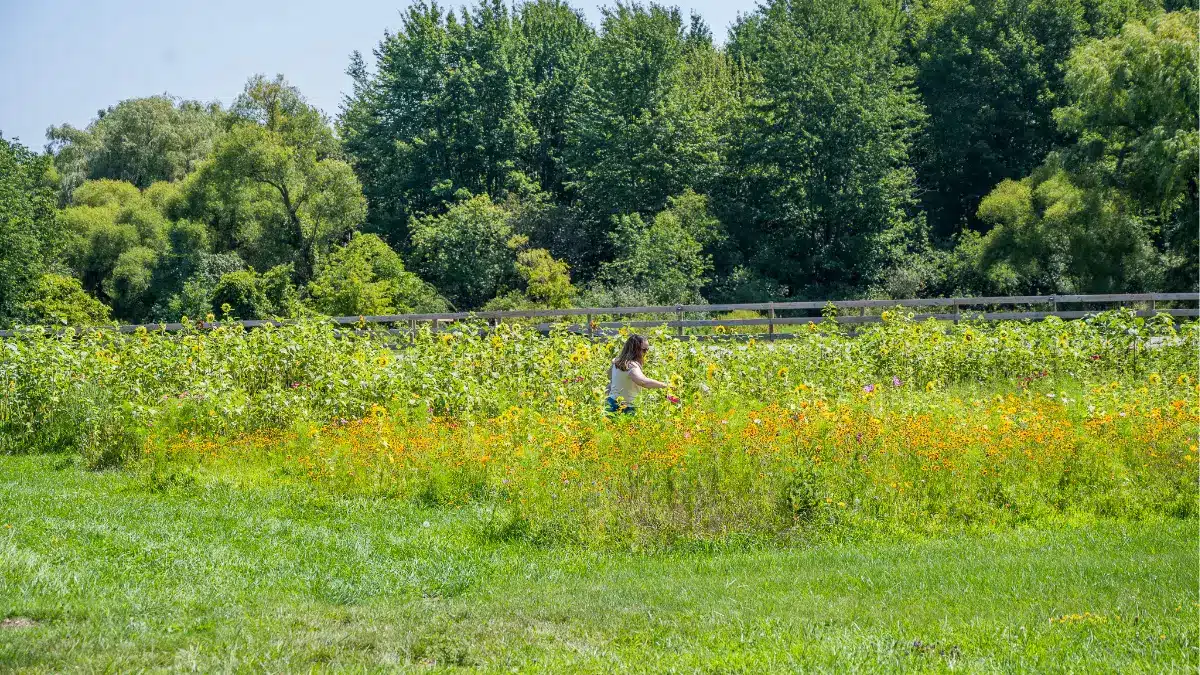
Twenty-five acres of commercial wildflowers and sunflowers peak from late June through August. This is the season for couples whose vision includes flower fields as part of the ceremony or portrait locations. Evening ceremonies avoid the afternoon heat. The golden-hour light across the fields in late July is something photographers who shoot here consistently return to.
Spring (April–May) — Shoulder Season Value
The wildflowers begin emerging, the Highland cattle may have new calves on the hillside, and the property pricing is more flexible than peak fall or summer weekends. Rain is a realistic possibility in April and early May — SRF’s indoor ceremony spaces are genuinely beautiful, not just functional fallbacks, so a weather pivot does not mean a compromised day.
Winter (November–March) — Most Intimate
Snow on the fields, wood stoves in the cabins, a private hot tub under cold air. Winter is the least-booked season at SRF, which means best availability, lowest pricing, and the most secluded version of the property. The 1837 Barn and Ceremony Barn are climate-controlled year-round. A winter elopement here is not a compromise — it is a specific, quiet, memorable aesthetic that photographs unlike anything else.
FAQ: Eloping in Ohio
Can you elope in Ohio?
Yes. Ohio is one of the more elopement-friendly states logistically. There is no waiting period — you can receive your marriage license and legally marry the same day. The process starts at the county probate court where one of you lives, or at the county where the ceremony will take place if neither of you is an Ohio resident. For ceremonies at Standing Rock Farms, that is Lake County Probate Court in Painesville.
How much does it cost to elope in Ohio?
A minimal Ohio elopement — the two of you, an officiant, a marriage license, and one night of lodging — typically starts around $3,000 to $5,000 all-in. A fully produced farm elopement with a photographer, florals, a private dinner, and two nights of on-site lodging at a venue like Standing Rock Farms runs $8,000 to $15,000, depending on vendor choices and the number of guests. Both represent a significant reduction from Ohio’s average traditional wedding cost of $33,000 to $40,000.
Can you get married the same day in Ohio?
Yes. Ohio has no mandatory waiting period. Once your marriage license is issued at the probate court, you are legally permitted to marry that same day. Schedule your courthouse appointment for the morning of your ceremony and you can be married that afternoon.
Do you need a permit to elope in an Ohio state park?
Yes. Ceremonies in Ohio state parks and on public land generally require a special use permit obtained in advance from the park or the Ohio Department of Natural Resources. Private venues like Standing Rock Farms do not require permits — the ceremony takes place on private property.
Where are the best places to elope in Ohio?
State parks like Hocking Hills and Cuyahoga Valley National Park offer dramatic natural settings for couples who want a wild, public-land experience. Private farm venues in the Grand River Valley wine region of Northeast Ohio — Lake and Ashtabula counties — offer a complete destination experience: private acreage, on-site lodging, dedicated ceremony spaces, and 30-plus wineries within a short drive. The right answer depends on whether you need a permit-dependent public setting or a fully private destination.
Can we bring guests to our Ohio elopement?
Yes. A true elopement is typically 2 to 5 people, but there is no legal requirement limiting guest count. Micro-ceremonies of up to 30 guests are increasingly common and provide the intimacy of an elopement with the shared experience of a celebration. Venues like Standing Rock Farms have dedicated ceremony spaces for 5 to 50 guests specifically designed for this format.
The Setting Makes the Decision Easier
If the Northeast Ohio wine country and 450 private acres sounds like the right frame for your day — a working farm, dedicated ceremony spaces for intimate groups, on-site lodging for the night, and Grand River Cellars five minutes down the road for the morning after — Standing Rock Farms has built their micro-wedding and elopement experiences around exactly this.
Fall 2026 dates are available now. The best way to start is an inquiry, a tour, and a conversation about what your day should actually look like.
| Explore micro weddings and elopements at Standing Rock Farms → |
Read the complete Standing Rock Farms micro wedding venue guide